본문
Clarifying Rules for Virtual Asset Transfer Businesses and Restructuring Overseas Payment Businesses
- Newsletters
- 2026.10.19
On October 7, 2026, the Ministry of Finance and Economy published a proposed partial amendment to the Enforcement Decree of the Foreign Exchange Transactions Act (the “Proposed Amendment”). The Proposed Amendment clarifies the definition of virtual asset transfer business and its registration and supervisory framework. It also brings small-sum overseas remittance businesses and other specialized foreign exchange businesses under a single overseas payment business category, consisting of six business types, including new categories for payment escrow and electronic bill presentment and payment. In addition, the Proposed Amendment introduces personnel and capital requirements for currency exchange businesses, increases administrative surcharges that may be imposed instead of business suspension, and expands the Korea Customs Service’s authority to inspect foreign exchange transactions.
The public-comment period runs through October 26, 2026. The Proposed Amendment is scheduled to take effect on December 3, 2026, alongside the amended Foreign Exchange Transactions Act.
1. Clarifying Registration Requirements and the Regulatory Framework for Virtual Asset Transfer Businesses
2. Restructuring Small-Sum Overseas Remittance and Other Specialized Foreign Exchange Businesses as Overseas Payment Businesses
3. New Registration Requirements and Stronger Sanctions for Currency Exchange Businesses
4. Expanded Korea Customs Service Authority to Inspect Foreign Exchange Transactions
5. Key Implications
1. Clarifying Registration Requirements and the Regulatory Framework for Virtual Asset Transfer Businesses
The Proposed Amendment clarifies the scope and regulatory framework for the virtual asset transfer business newly introduced under the Foreign Exchange Transactions Act to monitor cross-border virtual asset transfers.
(1) Scope of Virtual Asset Transfer Business
The amended Foreign Exchange Transactions Act defines a virtual asset transfer business as a business in which a virtual asset service provider transfers virtual assets between Korea and another country through sales, purchases, exchanges, or other acts prescribed by Presidential Decree. It also covers acts prescribed by Presidential Decree that have substantially the same effect. The Proposed Amendment further specifies the following activities as falling within this business:
(i) Transferring virtual assets between Korea and another country through business activities such as virtual asset custody or management, or brokerage, arrangement, or agency services for the sale, purchase, or exchange of virtual assets
(ii) Transferring virtual assets between a virtual asset service provider and a virtual asset address not operated by a virtual asset service provider, where the transfer has substantially the same effect
(2) Registration Requirements and Procedures
The Proposed Amendment specifies the information to be included in applications to register a virtual asset transfer business, the applicable registration requirements, and the procedures for reporting changes to registered information or a business closure. In particular, applicants must meet the following requirements:
• Physical requirements: IT systems and facilities capable of supporting virtual asset transfer operations and related follow-up management
• Personnel requirements: At least two individuals at each business location who either have two or more years of foreign exchange experience or have completed training designated by the Minister of Finance and Economy
(3) Inspection, Sanctions, and Information Management
The Proposed Amendment adds virtual asset transfer business operators to the entities that the Minister of Finance and Economy may have inspected by the Financial Supervisory Service (“FSS”). It also provides a basis for notifying the Financial Services Commission (“FSC”) of information on transactions, payments, receipts, and fund movements governed by the Foreign Exchange Transactions Act, and further clarifies the delegation of related powers.
Virtual asset transfer business operators must report details of virtual asset transfers to the Foreign Exchange Information Center (the Bank of Korea’s foreign exchange information system). The reported information is expected to be shared with the National Tax Service, the Korea Customs Service (“KCS”), the FSS, and the Korea Financial Intelligence Unit for their respective functions, creating an integrated monitoring framework for cross-border virtual asset transfers.
2. Restructuring Small-Sum Overseas Remittance and Other Specialized Foreign Exchange Businesses as Overseas Payment Businesses
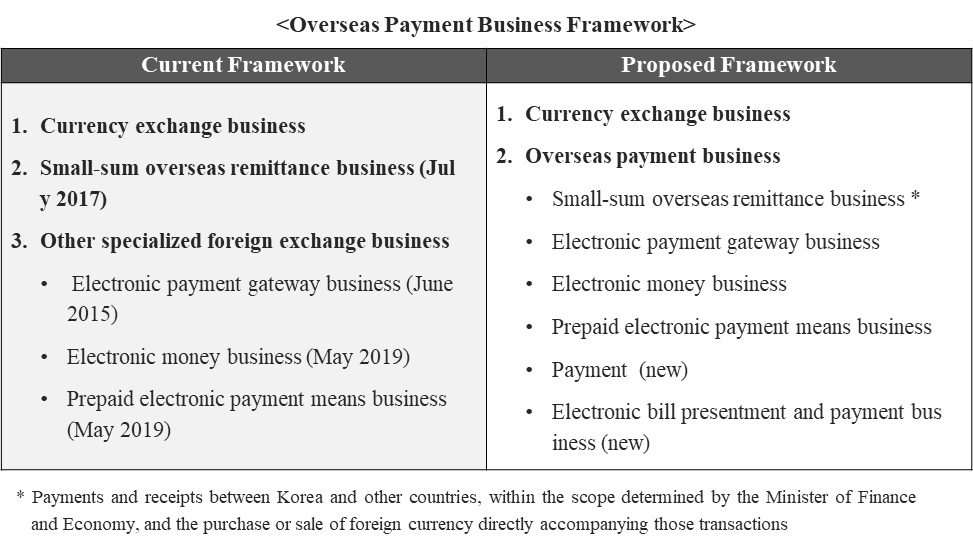
The Proposed Amendment consolidates small-sum overseas remittance businesses and other specialized foreign exchange businesses into a single overseas payment business category and comprehensively reorganizes their business scope and registration requirements. The overseas payment business will comprise six types: small-sum overseas remittance; three existing categories of other specialized foreign exchange business—electronic payment gateway, electronic money, and prepaid electronic payment means; and two new categories—overseas payment escrow and overseas electronic bill presentment and payment. Except for small-sum overseas remittance, the definitions of the other five business types follow the Electronic Financial Transactions Act.
Under the transitional provisions, existing small-sum overseas remittance businesses and other specialized foreign exchange businesses will be deemed registered for the overseas payment business corresponding to their existing operations. Those that do not meet the revised registration requirements must do so by June 30, 2027. The inspection and supervisory framework will also be reorganized, with inspection duties entrusted to the FSS and supervisory duties to the FSC.
Previously, transfers of foreign-currency prepaid electronic payment means were restricted and required a regulatory exemption under the financial regulatory sandbox. The Ministry of Finance and Economy has indicated that, after the Enforcement Decree is finalized, it plans to amend the Foreign Exchange Transactions Regulations to permit transfers of these instruments to third parties up to a specified limit.
3. New Registration Requirements and Stronger Sanctions for Currency Exchange Businesses
Currency exchange businesses have been criticized for having lower entry requirements and less robust sanctions than other non-bank financial sectors. To address these concerns, the Proposed Amendment introduces the following requirements:
• Personnel requirement: Executives must not be disqualified under Article 5(1) of the Act on Corporate Governance of Financial Companies
• Capital requirement: Equity capital of at least KRW 10 million, or such higher amount as may be prescribed and announced by the Minister of Finance and Economy
The Proposed Amendment also allows registration to be revoked for violations involving voice phishing, illicit trade payments, or unlawful cross-border remittances involving virtual assets. It further raises administrative surcharges in lieu of business suspension to as much as 100% of the benefit obtained from the violation, in cases equivalent to a four-month business suspension.
4. Expanded Korea Customs Service Authority to Inspect Foreign Exchange Transactions
The Proposed Amendment expands the KCS’s inspection authority so that it may continue its review of violations involving services or capital transactions that it identifies while inspecting export or import transactions. Currently, the KCS may inspect only the parties and related persons involved in export or import transactions and directly related services or capital transactions. Under the Proposed Amendment, the scope will also include parties and related persons involved in services or capital transactions where violations are identified during an export or import inspection.
5. Key Implications
(1) Virtual Asset Service Providers Should Assess Whether Registration Is Required
Under the Proposed Amendment, a virtual asset transfer business may include not only transfers between Korean and overseas virtual asset service providers, but also transfers between Korean virtual asset service providers and personal wallets. For example, where a Korean exchange allows customers to withdraw virtual assets to non-custodial personal wallets*, the service may fall within the virtual asset transfer business if the transfer is between Korea and another country or has substantially the same effect.
* A wallet in which the user directly holds and fully controls the private key, without the involvement of a third party such as an exchange
Virtual asset service providers should therefore review whether their current services limit wallet addresses to wallets operated by Korean providers or support transfers to overseas virtual asset service providers or personal wallets. If registration may be required, they should confirm the relevant requirements—including IT systems and qualified personnel—and prepare in advance for registration and connection to the Bank of Korea’s foreign exchange information system.
(2) Overseas Payment Businesses Should Confirm Registration Requirements for Each Business Type
The Proposed Amendment appears intended to extend the registration and information-management standards that previously applied to small-sum overseas remittance businesses across overseas payment businesses generally, thereby addressing potential supervisory gaps in comparable cross-border payment and settlement services.
Electronic financial businesses and fintech companies may need to satisfy not only licensing or registration requirements under the Electronic Financial Transactions Act, but also separate registration requirements for overseas payment businesses under the Foreign Exchange Transactions Act. Businesses operating multiple overseas payment types may also need additional foreign exchange specialists. In particular, businesses operating three or more types must employ at least five specialists, which may increase staffing and administrative burdens. Existing small-sum overseas remittance and other specialized foreign exchange businesses are deemed registered for the corresponding overseas payment business, but must meet the revised requirements by June 30, 2027 if they do not already do so. Businesses should therefore identify their current service types and any concurrent operations, review their registration requirements and internal controls, and prepare any necessary staffing or system enhancements.
(3) Service Providers Should Strengthen Transaction-Information Management, Reporting, and Inspection Readiness
The Proposed Amendment details the reporting, inspection, and sanction framework for virtual asset transfer businesses and brings cross-border virtual asset transfers within the foreign exchange authorities’ supervisory framework. In addition to satisfying registration requirements, affected businesses should establish systems to collect, manage, and report transaction information as required in the course of their operations.
As the scope of reportable information on virtual asset transfers expands and as the transfers involving personal wallets may also be subject to oversight, businesses should assess whether information-management systems originally designed around transfers between service providers can also capture and retain the necessary information for transactions involving personal wallets.
Regulatory and enforcement risk may also increase as administrative surcharges in lieu of business suspension rise and the KCS’s foreign exchange inspection authority expands. Fintech companies offering virtual asset or cross-border payment and settlement services should assess whether their services could be used to circumvent foreign exchange rules, facilitate unlawful transactions, or support money laundering, and should strengthen transaction monitoring and unusual-transaction response procedures accordingly.
Drawing on extensive experience advising financial institutions, platforms, and fintech companies, Yoon & Yang’s Digital Finance Center provides practical, tailored legal advice. Please contact us if you have any questions about these developments.
- Practice Areas
- #Digital Finance Center