본문
The Looming Global Real Estate Maturity Wall
- Newsletters
- 2026.06.02
Trillions of dollars in commercial real estate (CRE) loans originated during the era of low interest rates are now approaching maturity in rapid succession, colliding head-on with a persistent high-interest-rate environment. As this so-called “Maturity Wall” materializes, Korean institutional investors—holding an estimated KRW 55 trillion (roughly USD 40 billion) in overseas real estate alternative investment portfolios — find themselves directly in the line of impact. This newsletter provides a comprehensive overview of the current landscape and structural drivers of the Maturity Wall, the legal and financial risks facing Korean institutional investors, phased strategies to proactively navigate the crisis, and the role of legal counsel in addressing and navigating these challenges.
1. The Unprecedented Refinancing Pressure
2. Key Risks Facing Korean Institutional Investors
3. Proactive Mitigation: Early Warning Signals Before Maturity and Events of Default
4. The Role of Legal Counsel: A Phased Action Plan for Navigating the Crisis
1. The Unprecedented Refinancing Pressure
Large-scale commercial real estate (CRE) loans originated during the ultra-low interest rate environment of 2020–2021 are now reaching maturity in rapid succession/. This has triggered an unprecedented refinancing squeeze, heavily concentrated in the United States.
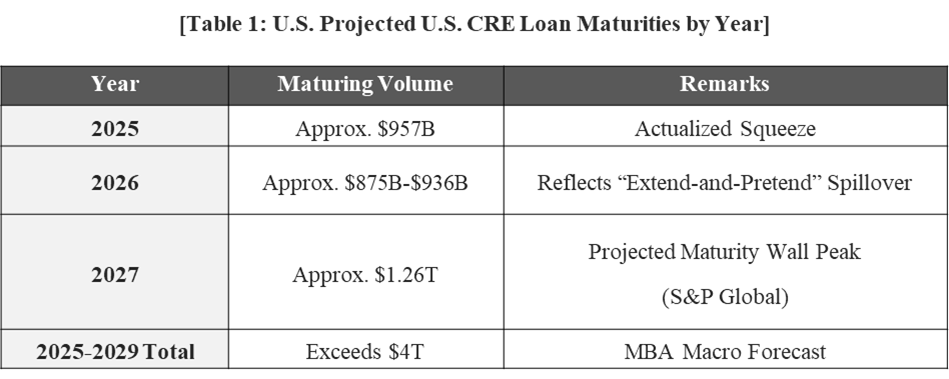
According to the Mortgage Bankers Association (MBA), approximately $957 billion in CRE loans are set to mature in 2025, followed by $875 billion to 936 billion slated for 2026, with total maturing CRE debt projected to exceed $4 trillion between 2025 and 2029. S&P Global forecasts that this “Maturity Wall” will reach its absolute peak in 2027, facing a staggering $1.26 trillion cliff.
This systemic risk has been severely compounded by the widely adopted "Extend-and-Pretend" strategy. Following aggressive interest rate hikes, senior lenders and major commercial banks chose to repeatedly rolled over maturing loans to defer immediate loss recognition. It is estimated that nearly $600 billion in maturities were artificially extended in 2025 alone. A study by the Federal Reserve Bank of New York (NY Fed) revealed that these legacy extensions clogged bank balance sheets, building up a latent Maturity Wall equivalent to 27% of total bank capital.
However, with stricter regulatory enforcement under Basel III capital requirements and heightened CMBS (Commercial Mortgage-Backed Securities) reporting obligations, lenders are rapidly running out of runway to extend these loans. The delinquency rate for Office CMBS skyrocketed to 12.34%, hitting an all-time high and signaling that distressed defaults are now breaking the surface.
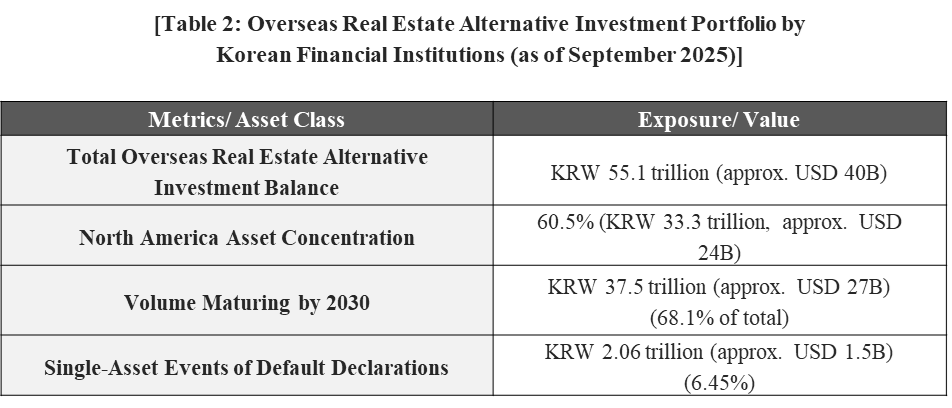
(Source: Financial Supervisory Service (FSS), "Current Status of Financial Companies' Overseas Real Estate Alternative Investments as of End of September 2025," March 17, 2026.)
2. Key Risks Facing Korean Institutional Investors
Having aggressively acquired overseas commercial office properties during the peak market (2018–2021), Korean institutional investors now find themselves directly in the crosshairs of the Maturity Wall. The critical legal and financial exposures include:
A. Subordinated Creditor Legal Exposure: Standstill Restrictions and Cure Rights
Korean investors predominantly entered these cross-border transactions as mezzanine lenders or equity investors (collectively, "Subordinated Investors"). Given the sharp contraction in asset valuations coupled with refinancing failures, senior lenders will inevitably seep the proceeds under the post-default waterfall. Consequently, Subordinated Investors face an acute risk of total principal wipeout.
Under these circumstances, two common law mechanisms—Standstill Provisions and Cure Rights—become central legal battlegrounds. It is critical to note that continental civil law regimes, including the Korean Commercial Code and the Financial Investment Services and Capital Markets Act (FISCMA), contain no equivalent statutory protections; thus, these rights are governed strictly by contract.
✓ Standstill provisions: Typically embedded within the Intercreditor Agreement, these clauses dictate that while a Senior Lender may temporarily defer enforcement/foreclosure actions during a default, the Subordinated Investors are completely barred from taking independent legal recourse during the designated standstill period (typically 90 to 180 days).
Example: Even if the underlying SPC borrower defaults on an interest payment, triggering an event of default (EOD), a Standstill Provision legally paralyzes the Subordinated Investors from: (i) independently foreclosing on collateral, (ii) accelerating their portion of the loan, or (iii) initiating standalone litigation against the borrower. This guarantees the Senior Lender complete dominion over workouts or liquidation.
– Strategic Bottlenecks: This strips Subordinated Investors of operational timing, diminishes their leverage in restructuring negotiations, and frequently results in severe information asymmetry as senior lenders manage asset disposition behind closed doors.
✓ Cure Rights: This mechanism empowers Subordinated Investors to step into the shoes of a defaulting SPC borrower to cure an EOD (e.g., by advancing delinquent interest payments or injecting additional collateral), thereby halting the Senior Lender’s foreclosure.
– Inherent Limitations: Cure Rights are strictly time-bound (typically expiring within 10 to 30 business days post-EOD) and are subject to strict frequency caps (e.g., a maximum of two cures per rolling 12-month period). Furthermore, exercising a Cure Right demands immediate capital injections, forcing institutions into a difficult fiduciary dilemma: throwing good money after bad in an unrecovered asset.
B. The Legal Dilemma of “Extend-and-Pretend” — Conditions and Risks of Loan Extensions
When overseas senior lenders offer to extend a maturity, they invariably demand strict concessions: (i) equity cure injections to offset Loan-to-Value (LTV) breaches, (ii) substantial interest rate step-ups, and/or (iii) parental guarantees. This places Korean Limited Partners (LPs) in a double-bind:
✓ Consent: Injecting cash risks further capital loss if cap rates continue to expand, while fixed operational costs, FX hedging fees, and GP management fees persistently erode fund net asset value (NAV).
✓ Refusal: Rejecting the cash call prompts the Senior Lender to immediately declare an EOD, initiate a foreclosure sale, and lock in a 100% principal loss for the equity tranche.
C. Repercussions of a Formal Event of Default (EOD)
An EOD (event of default) arises when an SPC borrower breaches its obligations under a loan agreement, entitling the senior lender the right to accelerate the full outstanding loan balance prior to maturity. In the current market, where office valuations have dropped by up to 55.8% from their peaks, an EOD poses existential risks to Korean institutional equity investors.
(1) Immediate Foreclosure and Collateral Enforcement
Upon an EOD, the senior lender may immediately initial foreclosure or forced sale procedures., even before the loan matures. Under standard payment waterfalls, Korean institutional investors — as equity investors — holding equity or junior mezzanine positions stand last in line, recovering only what remains after both the senior lender and mezzanine lenders have been repaid in full. With office values having fallen by as much as 55.8% from their peak, it is rare for any proceeds to remain once the senior lender has been made whole, meaning equity investors face a near-certain total loss of principal.
(2) Sudden Loss of Negotiable Leverage
Prior to a declaration of EOD, Korean institutional investors retain some negotiating leverage, by offering additional capital injections or collateral as bargaining chips in discussions with the senior lender. Once an EOD is formally declared, however, the balance of power tilts decisively in favor of the senior lender. Armed with the ability to enforce its security at any time, the senior lender has little incentive to accept the terms proposed by Korean institutional investors, and may instead dictate terms that are squarely against the interests of equity investors.
(3) Cross-Default Risk
If the underlying loan agreement contains a cross-default clause, an EOD at a single asset level may trigger a chain reaction, defaulting other credit agreements held by the same SPC or affiliated entities. This creates a cascading default risk, whereby a problem at a single property spread across multiple assets — a particular concern for Korean institutional investors with exposure to multiple overseas real estate funds managed by the same GP.
(4) Time Constraints and Jurisdictional Asymmetry
The window to cure or respond post-EOD is exceptionally narrow. Once the Cure Right period (typically 10 to 30 business days) lapses or the Standstill period terminates, available legal remedies narrow sharply. Adding to the complexity, foreclosure procedures vary from state to state in the United States, and where the borrower (SPC) files for bankruptcy, enforcement may be halted altogether by an automatic stay under local bankruptcy law. Navigating these issues in a timely manner is extremely difficult without in-depth knowledge of the applicable local legal framework.
(5) Domestic Regulatory Sanctions and Compliance Exposure
Korean financial regulatory bodies, including the Financial Supervisory Service (FSS), mandate stringent quarterly reporting for overseas alternative investments. A formalized EOD forces institutions to recognize immediate credit losses and increase bad-debt reserves. Public or regulatory disclosure of an EOD triggers:
✓ Significant reputational damage within the capital markets.
✓ Mandatory board-level reporting under internal control standards.
✓ Stringent investor notification and disclosure obligations under the Financial Investment Services and Capital Markets Act (FSCMA).
Institutional investors exposed to properties where an EOD has occurred become subject to enhanced prudential oversight by financial regulators. The FSS publishes quarterly data on financial companies' overseas real estate alternative investments and actively encourages proactive loss recognition, requiring institutions to set aside adequate loan loss provisions for EOD-affected assets. Public disclosure of an EOD can give rise to a range of further consequences: (i) reputational risk for the institution, (ii) board reporting obligations under internal control standards and board regulations, and (iii) investor notification and disclosure obligations under the Financial Investment Services and Capital Markets Act and applicable fund documentation — all of which add to the internal compliance burden.
D. Currency Fluctuations and FX Hedging Capital Drains
Korean institutional investors typically manage currency exposure through FX hedges when investing in overseas assets. In the context of the Maturity Wall, however, hedging itself can give rise to new risk factors, as outlined below.
✓ Surging Hedging Costs: Widening interest rate differentials (particularly between the KRW and USD) have driven annualized FX hedging costs up to the 3% to 4% range. When subtracted from the asset's gross yield, these frictions frequently drag net real returns into negative territory.
✓ Maturity Mismatch and Liquidation Bottlenecks: A structural mismatch between the expiration of the FX hedge contract and the underlying fund's maturity poses severe risks upon fund extensions. LPs must bear substantial roll-over costs to execute swap extensions. A notable precedent involved a Belgian core office fund liquidation, where the hedge counterparty bank filed a pre-judgment attachment over unpaid swap settlement balances, severely paralyzing the entire fund dissolution and distribution process
E. Local Law Risks
Disputes arising from offshore real estate funds are generally governed by local law, which gives rise to the following risks:
✓ Structural Divergence in Security Interests: Standard Korean security structures, such as collateral trusts and kun-mortgages, operate under fundamentally different mechanics in foreign jurisdictions. For instance, US foreclosure procedures deviate heavily by state (judicial vs. non-judicial regimes), altering timeline buffers entirely.
✓ Insolvency Freeze (Automatic Stay): If the borrower SPC files for local bankruptcy protection, provisions such as the US Bankruptcy Code’s Automatic Stay will instantly freeze all foreclosure and enforcement actions. Navigating these local bankruptcy procedures to restore junior investor rights can delay capital recovery by multiple years.
✓ Localized Fiscal and Tax Frictions: Asset liquidations trigger complex local tax exposures—including capital gains tax, cross-border withholding tax, and Value-Added Tax (VAT)—which directly diminish the net recovery amount and must be structured preemptively.
3. Proactive Mitigation: Early Warning Signals Before Maturity and Events of Default
When it comes to the Maturity Wall, by the time formal maturity arrives or an EOD is declared, it is already too late. The early warning signals outlined below are typical leading indicators of an EOD, and detecting them early is itself the first step in an effective crisis response. As soon as any of these signals emerge, investors should seek specialist legal advice to review their rights under relevant agreements — including the LPA (limited partnership agreement), intercreditor agreement, and security agreement — and begin formulating a response strategy without delay.
A. DSCR Breaches and the "Cash Trap"
The Debt Service Coverage Ratio (DSCR)-- the ratio of Net Operating Income (NOI) to annual debt service— is typically covenanted between 1.10 to 1.25 or above. If vacancies rise and NOI drops below this threshold, senior lenders activate a Cash Trap.
All cash flow is diverted from operational accounts into a lender-controlled escrow account. While a Cash Trap is not an immediate loss-crystallizing event, it blocks all equity distributions (dividends). Over time, fixed fund expenses (GP management fees, FX hedging costs) continue to mount, eroding the fund's liquidity and signalling imminent EOD considerations by the lender.
B. LTV Breach
The loan-to-value ratio (LTV) is calculated by dividing the outstanding loan balance by the current market value of the collateral property. If asset depreciations push the LTV past the covenanted ceiling, senior lenders can demand:
✓ Immediate equity cure (cash injection),
✓ Partial loan paydown, or
✓ Declaration of an EOD.
With prime office assets down over 50%, assets acquired with a 70% LTV during low-interest cycles frequently see current LTVs exceeding 100%. In such scenarios, the collateral no longer covers even the senior debt principal, making immediate foreclosure the lender's most rational economic choice. Therefore, an LTV breach requires far more urgent legal intervention than a DSCR breach.
C. Tenant Credit Deterioration
A decline in the credit rating of key tenants, refusal to renew leases or early termination, and persistently rising vacancy rates all reduce NOI, triggering a chain reaction of DSCR deterioration and declining asset values. While deteriorating tenant credit does not in itself trigger an EOD, it is the most common pathway leading to the specific EOD triggers discussed above — a DSCR shortfall and an LTV breach.
Single-tenant properties are particularly vulnerable to this risk. Where there is only one tenant, its departure immediately drives NOI to zero and causes a sharp drop in asset value, which can simultaneously trigger both a DSCR shortfall and an LTV breach. Given that a significant number of overseas office funds held by Korean institutional investors were structured around a single tenant — such as a government agency or a large corporation — monitoring for this signal is especially important.
D. Refinancing Failure
As maturity approaches, the most dangerous scenarios are: (i) failure to secure a new lender, (ii) the existing senior lender's refusal to extend, and (iii) a significant deterioration in refinancing terms — such as a sharp rate increase or excessive additional equity requirements — any of which can result in an immediate EOD. That said, scenario (iii) warrants separate consideration: rather than a direct EOD trigger, it is better understood as a scenario that significantly erodes equity investor returns or imposes additional capital burdens.
Unlike DSCR shortfalls, LTV breaches, and deteriorating tenant credit — which can generally be detected in advance through ongoing monitoring — refinancing failure is particularly time-sensitive given the fixed nature of the loan maturity date, making advance preparation all the more critical. It is advisable in practice to begin regularly monitoring the lenders' stance, market interest rate trends, and new lenders' appetite at least 12 months before maturity, so that early warning signs can be identified without delay.
4. The Role of Legal Counsel: A Phased Action Plan for Navigating the Crisis
The offshore real estate maturity wall crisis is not merely a financial challenge — it demands a deep understanding of complex cross-border transaction structures and local legal frameworks. From the point at which early warning signals first emerge through EOD, restructuring, and exit, the timing and strategy of legal response are what ultimately determine the scale of losses. Negotiations with local lenders, interpretation of intercreditor agreements, decisions on whether to exercise cure rights, and restructuring negotiations all sit at the intersection of local and Korean law — including the Financial Investment Services and Capital Markets Act — making these areas where missing the window for action is all too easy without specialist legal advice.
Drawing on deep expertise across domestic and overseas real estate fund investment and financial transactions, Yoon & Yang LLC’s Alternative Investment Practice Group is committed to providing practical, strategic legal services at every stage of the Maturity Wall crisis response, as set out below.
[STEP 1. Six Months Before Maturity: Full Contract Review and Securing Negotiating Leverage]
The most important principle in crisis response is securing negotiating leverage before the senior lender formally signals its intention to refuse an extension. To that end, it is necessary to comprehensively review the loan agreement, security agreement, and intercreditor agreement at least six months before maturity. Key areas to examine include the following.
• Cure Right: Examine the exercise window (typically 10 to 30 business days following an EOD), any caps on the number of exercises (e.g., twice within any 12-month period), and the conditions for exercise. Where cure rights exist, they represent the most direct defensive tool available to junior investors immediately upon an EOD.
• Standstill Provisions: Examine the trigger conditions, the standstill period (typically 90 to 180 days), the scope of junior investors' information access during the standstill period, and the extent to which rights are restored upon its expiry.
• Waiver/Consent Provisions: Determine whether it is possible to prevent an EOD from being triggered by obtaining a waiver or consent from the senior lender in respect of any loan agreement breaches
• Debt Purchase Right: Where the intercreditor agreement grants junior investors the right to purchase the senior loan, exercising this right allows them to step into the senior lender's position — effectively blocking an EOD declaration, security enforcement, or forced sale, while gaining control over the timing and terms of any asset disposal. That said, this right is typically exercisable only within a limited window (e.g., during the standstill period or before enforcement commences), and the purchase price is generally set at the full outstanding principal and interest of the senior loan. The feasibility and cost implications should therefore be carefully assessed in advance.
• Prepayment & Break Costs: Quantify any prepayment penalties or break costs that would arise if the SPC repays the senior loan early — whether ahead of an EOD or before maturity. Since the funds required for early repayment are often sourced through additional capital contributions from equity investors, it is worth carefully analyzing, from an investor returns perspective, whether absorbing the prepayment penalty is economically preferable to the losses that would result from a forced sale by the senior lender.
Yoon & Yang LLC's Alternative Investment Practice Group conducts a thorough analysis of contractual rights at this stage to lay the groundwork for subsequent negotiation strategy, ensuring clients are positioned to negotiate from the strongest possible footing.
[STEP 2. Three Months Before Maturity: Negotiating a Loan Extension with the Local Lender]
It is imperative to initiate negotiations with the local senior lender without delay, drawing on the contract review. Coming to the table before the senior lender sets the terms is key to preserving negotiating leverage. The main items for negotiation are as follows.
• Maturity Extension: Approach the negotiation with a concrete asset recovery plan and operational update, focusing the discussion on the terms of the extension — including the scale of any additional equity injection, the extent of any rate increase, and additional collateral requirements.
• Interest Rate Terms: Negotiate to minimize rate increases or explore a conversion to a fixed rate, with a view to reducing the additional interest burden.
• LTV Threshold Reset: Negotiate a revised LTV threshold that reflects current asset values, with a view to minimizing the additional equity injection required.
• Payment Deferral: Negotiate a temporary deferral of interest or principal repayments to relieve short-term liquidity pressure.
Yoon & Yang LLC's Alternative Investment Practice Group provides end-to-end support — from developing negotiation strategy to managing communications with the local lender — drawing on professionals with in-depth knowledge of local law.
[STEP 3. Before and After an EOD: Reviewing the Intercreditor Agreement and Assessing Whether to Exercise Cure Rights]
Where an EOD has occurred or is imminent, the intercreditor agreement must be reviewed immediately and in detail. The window to exercise cure rights is typically no more than 10 to 30 business days from the EOD, leaving no margin for delay — immediate legal advice and decisive action are required. Key areas for review are as follows.
• Cure Right Execution Analysis: Quickly assess — on both financial and legal grounds — whether exercising cure rights is economically justified: does the prospect of asset recovery warrant the additional capital outlay?
• Information Extraction via Standstill: Where a standstill has been triggered, work to obtain as much information as possible during the standstill period regarding the senior lender's asset disposal plans, valuation results, and proposed sale terms, so as to prepare for subsequent action.
• Debt Purchase Right: Where the intercreditor agreement provides for this right, consider purchasing the senior loan directly to step into the senior lender's position — blocking enforcement of security and gaining control over the timing and terms of any asset disposal.
• Navigating local law: Address local law-specific issues arising after an EOD, including the enforcement process, available defenses against foreclosure, and the potential use of automatic stay protections under local bankruptcy law.
[STEP 4. STEP 4. Loan Restructuring and Recapitalization Negotiations]
Where refinancing is not viable or exercising cure rights is not practicable, loan restructuring and recapitalization should be explored. At this stage, complex legal issues arise simultaneously — including restructuring procedures under local law, defenses against security enforcement, and tax considerations — making accurate, integrated legal advice essential. The options available are as follows.
• Partial Paydowns: Repay a portion of the senior loan principal to bring the LTV back within the required threshold, thereby curing the EOD.
• Sponsor/Mezzanine Synthetics: Bring in new mezzanine or equity investors to restructure the capital stack.
• Debt Restructuring Agreement: Negotiate a restructuring arrangement covering principal reduction (haircut), interest rate reduction, and revised repayment schedule.
• Private Credit Facility Sourcing: In an environment where traditional bank lending is contracting, raise bridge or mezzanine financing through private credit funds to repay the existing senior loan or fill the capital gap.
Yoon & Yang LLC's Alternative Investment Practice Group swiftly assesses the legal viability of each restructuring scenario, designs the most favorable structure for the client, and provides strategic support throughout the negotiation process.
[STEP 5. STEP 5. Developing an Exit Strategy: The Last Resort for Minimizing Losses]
Where asset values continue to decline and restructuring is not viable, it may be more advantageous in the long run to lock in losses early and reallocate resources rather than continuing to hold. The major exit options are as follows.
• Secondary Sale of Fund Interests: Selling the institutional investor's LP interests directly to a third party in the secondary market allows for a quick exit at the LP level without going through an asset sale process by the SPC. While an asset sale can take years, a secondary transaction can typically be completed within months — and in some cases can be pursued independently without the GP's cooperation. The trade-off is that in a declining market, sellers are often required to accept a significant discount of 20% to 50% to NAV.
• Asset Sale: The SPC sells the underlying property directly to recover the investment. To achieve more favorable terms than a forced sale, it is important to secure the senior lender's consent in advance and allow sufficient time for sale preparation — though whether a sale is achievable and the amount recoverable will depend significantly on local market conditions. In particular, since pursuing a voluntary sale before the senior lender initiates foreclosure can make a substantial difference to the terms obtainable, it is important to proactively initiate the sale process while there is still time.
• Distressed Sale of Junior Interests: The institutional investor sells its mezzanine debt or equity interests to specialist distressed investors at a discount. Unlike a secondary sale — which involves selling the entire fund interest — this approach allows for the selective disposal of interests or claims relating to a specific distressed asset within a multi-asset fund. As this option also involves a significant discount, it is essential to carefully weigh the expected losses from continuing to hold against the losses that would be locked in through an immediate sale.
Regardless of which exit option is chosen, overlooking any of the following considerations can give rise to unexpected costs that significantly erode net proceeds.
• Local Tax Liabilities: The sale of an asset or interest may attract capital gains tax, withholding tax, or other levies under local tax law. It is essential to obtain tax advice to accurately determine the net after-tax proceeds.
• FX Hedge Break Costs: Exiting requires early termination of any remaining FX hedge positions, which can result in significant settlement costs depending on the difference between the contracted and prevailing market rates. Failure to settle hedge obligations can delay the entire exit process — making it essential to negotiate settlement terms with the hedging bank before proceeding with the exit.
• Local Property Sale Procedures and Timelines: The procedures and timelines for selling real estate vary by jurisdiction, and in the United States in particular, they differ from state to state. Specialized legal advice is essential.
• Potential Conflicts of Interest with the GP: GPs may have an incentive to favor continued holding in order to preserve management fee income, which can create a conflict of interest where an LP wishes to exit. The LPA should be carefully reviewed for any LP sale request rights and GP obligations to proceed with a sale.
Yoon & Yang LLC's Alternative Investment Practice Group has the capability to provide one-stop support through the entire exit process — from designing the optimal exit scenario tailored to the client's circumstances, to reviewing the legal validity of secondary sales, advising on local tax and legal matters, and handling disputes arising from conflicts of interest with the GP.
- Practice Areas
- #Real Estate Financing ∙ Investing
Professionals


Previous
Yoon & Yang Wins Final Supreme Court Confirmation in a Global SaaS Corporate Income Tax Case Software and Service Fees Paid to a Foreign SaaS company Held to Be Business Income, Not Royalties — Full Refund of Withholding Tax Confirmed
Next
Espionage Law Amendment in 70 Years: Response Strategies for Cross-Border Businesses