본문
Key Considerations for Exporters Amid Heightened Enforcement of Strategic Item Controls
- Newsletters
- 2026.09.04
Under the Foreign Trade Act, exporters must obtain an export license or catch-all license (collectively, “export licenses”) before exporting either “strategic items,” which include dual-use items and munitions, or “catch-all controlled items.” Catch-all controlled items are items that are not classified as strategic items but are used, or are at risk of being diverted for use, in the development, manufacture, use, or storage of weapons of mass destruction (WMD) and their delivery systems. Together, strategic items and catch-all controlled items are referred to as “strategic items, etc.”
As strengthening trade security and the enforcement framework has become a key policy priority, the Korea Customs Service (KCS) has expanded its dedicated trade-security enforcement organization and personnel to combat unauthorized exports of strategic items, etc. Exporters handling such items should therefore exercise particular care. Notably, “strategic items, etc.” may include not only tangible goods, but also intangible items and technologies in electronic form, including software and technical data.
1. Enforcement Trends in Illicit Exports of Strategic Items
2. Implications for Korean Exporters
1. Enforcement Trends in Illicit Exports of Strategic Items
In July, the Korea Customs Service (KCS) announced that, from January through May 2026, it had detected trade-security violations totaling KRW 770.3 billion. This amount already exceeds the total detected in the previous year. Of particular note, illicit exports of strategic items accounted for KRW 243.0 billion, highlighting the intensified enforcement environment.
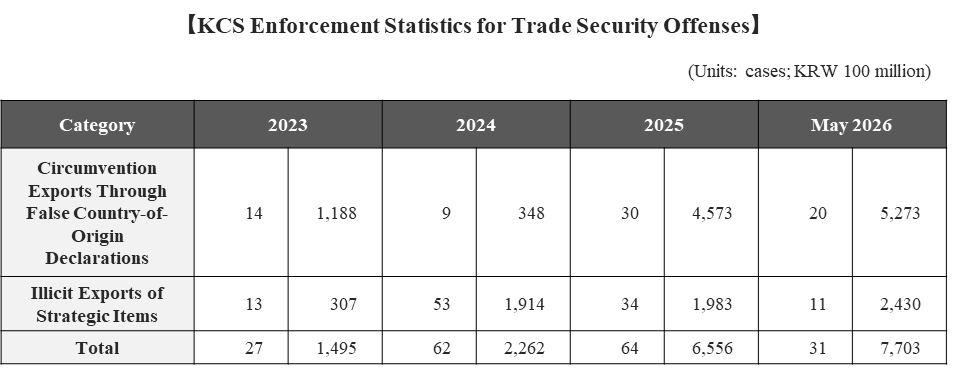
To advance the current administration’s policy priority of strengthening trade security and establishing a robust enforcement framework, the KCS launched the Special Trade Security Task Force in February of last year. In December of that year, it deployed dedicated trade-security investigation units at major frontline customs offices—one division each at Incheon and Busan Customs and one team at Seoul Customs. In February of this year, the KCS further formalized this structure by establishing a dedicated Trade Security Investigation Division.
The establishment of a centralized trade-security organization within the KCS has also laid the foundation for closer coordination with domestic authorities, including the Ministry of Trade, Industry and Energy (MOTIE) and the National Intelligence Service (NIS), as well as overseas counterparts such as U.S. Customs and Border Protection (CBP) and Homeland Security Investigations (HSI).
2. Implications for Korean Exporters
Following the Russia–Ukraine war, the number of items subject to catch-all licensing requirements for export to Russia has increased sharply, from 57 items in 2022 to 1,402 items today. This reflects Korea’s efforts to comply with international export-control regimes designed to prevent the transfer of materials and technologies that may contribute to the development or manufacture of weapons of mass destruction (WMD), including nuclear, chemical, biological, and missile-related capabilities.
As a result of amendments to the Foreign Trade Act and related regulations made to align with these international export-control regimes, items that were previously exportable without restrictions are increasingly being newly designated as strategic items, etc.
Some exporters, unfamiliar with the Foreign Trade Act and regulations governing strategic items, etc., may fail to keep pace with these legislative and regulatory changes. There have therefore been cases in which exporters shipped newly designated strategic items, etc. without obtaining the required export licenses and were subsequently detected and sanctioned.
Exporting strategic items, etc. without the required export licenses may violate the Foreign Trade Act and the Customs Act. Such violations may result in criminal penalties as well as administrative sanctions, including restrictions on the export of strategic items, etc. for up to three years.
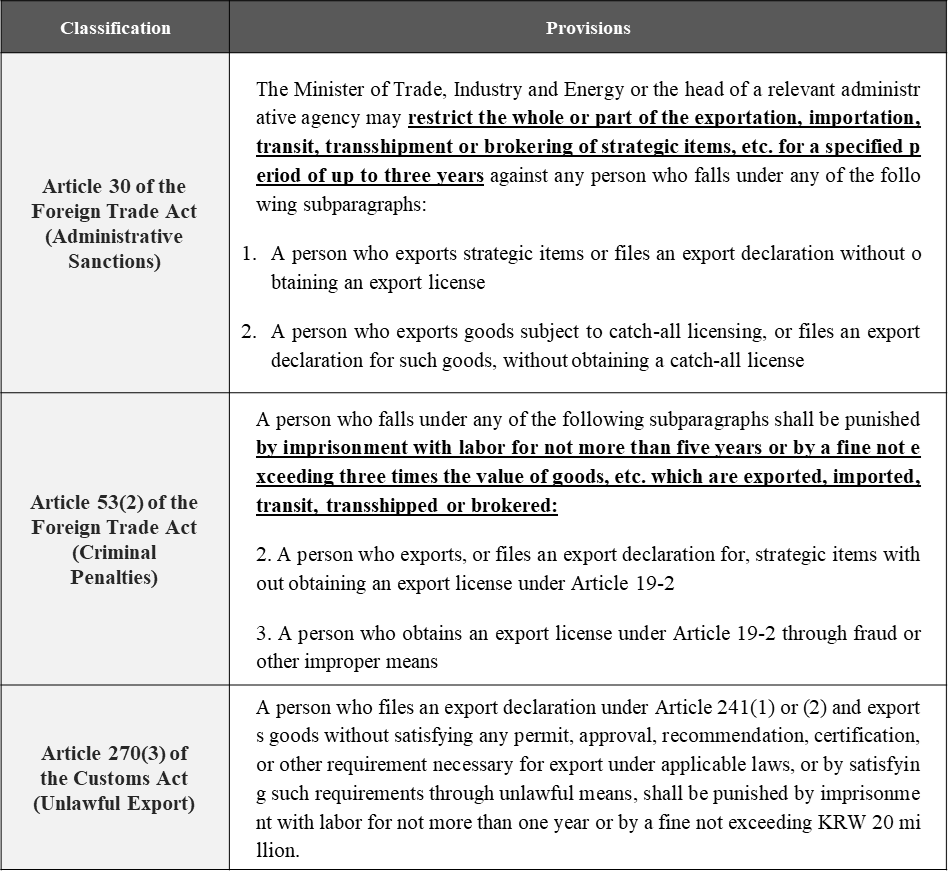
Even where an exporter did not intentionally evade export-control requirements, exporting strategic items, etc. without the necessary authorization may trigger the penalties described above and have serious operational consequences. Exporters should therefore maintain robust compliance controls. They should also note that the scope of strategic items, etc. expressly extends beyond tangible goods—such as materials, equipment, and components—to include intangible items and technologies in electronic form, including software, blueprints, technical data, and related intellectual property.
Yoon & Yang’s Customs and Trade Practice Group comprises professionals with extensive practical experience in customs and foreign-exchange matters, including experience at the Ministry of Economy and Finance (MOEF), the Korea Customs Service (KCS), and customs offices. In collaboration with Yoon & Yang LLC, we provide comprehensive legal services across customs, trade, and foreign-exchange matters, including customs valuation, trade compliance, export controls, and foreign-exchange regulation.
If you require assistance with customs compliance, trade security, or foreign-exchange matters, please do not hesitate to contact our Practice Group.
- Practice Areas
- #Tax ∙ Customs ∙ Foreign Exchange